-285x43.webp "BALTICDIAG")











































-150x150w.webp)















Essential Equipment for Electric and Hybrid Vehicle Workshops in 2026
Essential Equipment for Electric and Hybrid Vehicle Workshops in 2026
Guide for EV, PHEV, HEV workshop owners · BalticDiag
Electric and hybrid vehicles are rapidly becoming the preferred choice for drivers across the world. Rising environmental awareness, lower operating costs, government incentives, and significant improvements in battery performance have made these vehicles practical and attractive for everyday use. The growing number of EVs and hybrids on the road is transforming the automotive landscape and creating entirely new demands for vehicle maintenance and repair.
Workshops that were designed for conventional internal combustion engines can no longer rely on standard tools and traditional procedures. Servicing electric vehicles and hybrid vehicles — whether fully electric, plug-in hybrid (PHEV), or mild hybrid (MHEV) — requires a fundamentally different approach. High-voltage systems, complex electronics, and advanced battery management technologies must be handled with precision and care. Investing in the right electric vehicle service tools and hybrid vehicle repair tools is no longer optional for any workshop that wants to remain competitive.
Hybrid vehicles present a unique challenge that is often underestimated. Unlike pure EVs, they combine a combustion engine with a high-voltage electric drive system, meaning technicians must be competent in both domains simultaneously. A degraded hybrid battery may not always trigger obvious fault codes. Capacity loss, cell imbalance, and cooling system faults can quietly reduce performance long before a customer notices a problem. This makes specialized diagnostic and battery testing equipment just as critical for hybrid service as it is for full EV repair.
This guide presents the essential EV workshop equipment and solutions that workshops should consider as electric and hybrid vehicles continue to grow in popularity, with tools and products available from BalticDiag - a trusted global distributor of professional automotive diagnostic and workshop equipment.
Diagnostic equipment
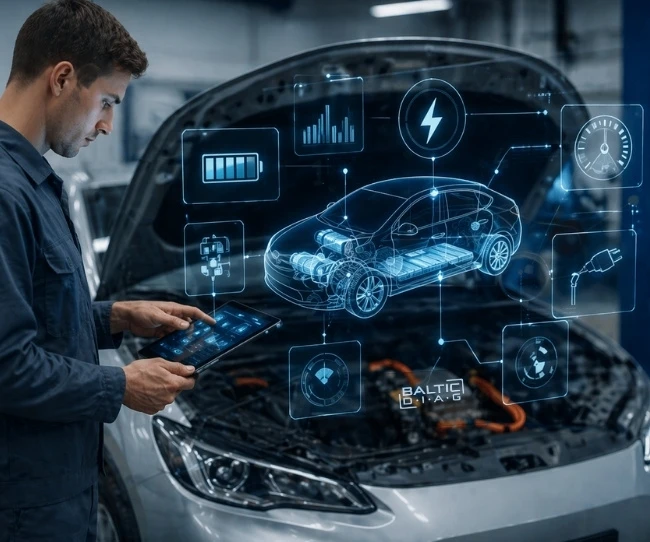
Diagnostic equipment for electric and hybrid vehicles provides direct access to the electronic and control systems that manage vehicle operation. These systems include battery management units, electric motors, inverters, and vehicle control modules. For hybrid vehicles, diagnostics must also cover the ICE side systems simultaneously, since a fault in either domain can affect overall drivability and fuel efficiency.
Whether a technician needs an EV scan tool for battery state of health checks, or a full hybrid diagnostic scanner covering both the combustion engine and the high-voltage drive system, choosing the right tool is critical for accurate and efficient service. High-quality diagnostic tools allow technicians to read fault codes, monitor real-time system data, perform calibrations, and verify system performance across the full range of EV, PHEV, and MHEV models.
Key features to look for:
- Read and clear fault codes across both HV and ICE systems - critical for hybrid vehicles
- Real-time live data monitoring including battery state of health, state of charge, cell voltages, and temperatures
- OBD diagnostics for electric vehicles with full system access including motor, inverter, and BMS
- System calibrations, adaptations, and resets
- Multi-brand compatibility covering EV, PHEV, and MHEV models from all major manufacturers
- Regular software updates to maintain support for new model years and evolving EV technologies
- Intuitive interface and clear service documentation output for efficient workshop workflow
Solutions from BalticDiag:
- SmartSafe
P03 SmartSafe EV detection & diagnostic tool
In-depth EV and hybrid system analysis, battery state of health monitoring, and preventive maintenance for garages and service centres.
- SmartSafe
P01 EV detection tool SmartSafe
Basic system detection and initial diagnostics for a wide range of electric and hybrid vehicles.
- SmartSafe
ST13 SmartSafe intelligent link terminal
Advanced hybrid diagnostic scanner with intelligent system linking for detailed fault detection and module analysis across HV and ICE systems.
- Texa
Multi-brand diagnostic system for passenger cars, covering ICE, hybrid (HEV/PHEV/MHEV), and electric vehicles. Provides full system access including engine, transmission, vehicle electronics, and high-voltage components such as battery, inverter, and electric motor.
The solution combines diagnostic hardware and IDC6 software, enabling fault code reading, live data, service functions, and calibrations with support for modern vehicle protocols (DoIP, CAN-FD).
Note: This product list is not exhaustive. Our managers can provide a personalized recommendation based on your workshop’s vehicle mix and service requirements.
Electrical testing & high-voltage safety equipment
Electrical test equipment consists of instruments that allow technicians to measure, verify, and evaluate the electrical properties of systems found in electric and hybrid vehicles. These tools are essential for confirming the integrity of wiring harnesses, battery insulation, and voltage levels during maintenance, troubleshooting, and post-repair verification.
Both full EVs and hybrid vehicles carry high-voltage battery packs - typically between 100 V and 800 V - making an EV electrical safety check with a dedicated insulation tester a mandatory step in any service workflow involving the HV system. Using a purpose-built electric vehicle insulation tester, rather than a general-purpose megohmmeter, ensures that test voltages and safety thresholds are correctly matched to automotive high-voltage battery specifications. Before and after any high-voltage system work on an EV or PHEV, an insulation resistance test should be performed and documented as part of standard workshop procedure.
Key features to look for:
- Insulation resistance measurement at high DC voltages suitable for HV battery packs in both EVs and hybrids
- Selectable test voltage levels to match different EV and PHEV architectures
- Clear visual display with pass/fail indication for fast, reliable assessment
- Data logging or export capability for service documentation and quality control
- Compliance with relevant high-voltage safety standards for automotive workshop use
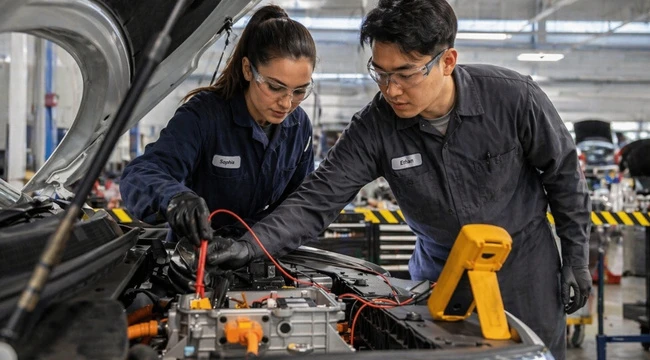
Solutions from BalticDiag:
- Launch
ES200 EV battery insulation resistance indicator
Measures insulation resistance and voltage on HV battery packs and supply lines. Suitable for EV electrical safety checks on both full EVs and PHEV hybrid systems.
- Autel
MaxiEV ITS100 insulation resistance tester
Applies selectable high DC voltages to detect insulation degradation in EV and hybrid battery components. Visualizes results clearly for reliable fault assessment.
- SmartSafe
IRT01 insulation resistance tester
Advanced measurement and data processing for regular high-voltage safety checks on EV and hybrid battery systems.
Lifting equipment
Lifting equipment is essential for safely handling electric and hybrid vehicles and their heavy components in a workshop. Both full EVs and PHEVs carry large battery packs that significantly increase vehicle weight compared to equivalent ICE models - in some cases adding 300–500 kg to kerb weight. Choosing the right workshop lift directly affects both technician safety and service efficiency across all vehicle types.
2-Post Lifts. A 2-post lift is one of the most common workshop lifts, offering excellent underbody access for general servicing, brake work, and drivetrain inspections. When used with EVs and hybrids, it is important to identify correct lifting points to avoid contact with high-voltage battery packs and cables running along the vehicle floor. Many modern 2-post lifts come with rubber-padded adapters specifically designed for EV chassis.
4-Post / Platform. Lifts 4-post platform lifts provide a stable, drive-on solution ideal for wheel alignment, suspension work, and full vehicle inspections. Their wide platform design distributes the increased weight of EV and hybrid vehicles evenly, making them well suited for heavier models. Some platform lifts also allow battery removal when used in combination with a battery lift table positioned underneath.
Scissor Lifts. In-ground and mobile scissor lifts offer a low-profile solution for workshops with height restrictions. They provide solid central support and are commonly used for tyre and wheel services. For hybrid and EV work, scissor lifts with extended platforms can accommodate the wider, heavier floor structures typical of battery-electric vehicles.
Battery and Component Lift Tables. EV and PHEV servicing often requires the removal of large, heavy battery packs. Dedicated EV battery lift tables are designed to safely support and lower high-voltage battery assemblies during removal and installation. These are an essential addition to any workshop handling electric or hybrid drivetrains, and should be rated well above the battery pack weight to ensure a safe working margin.
Mobile Column Lifts. Mobile column lifts are a flexible solution for larger or commercial hybrid vehicles such as vans and light trucks. Columns can be positioned independently around the vehicle, providing full underbody access without fixed infrastructure. This makes them particularly useful for workshops that service a mixed fleet of EV, PHEV, and HEV vehicles of varying sizes.
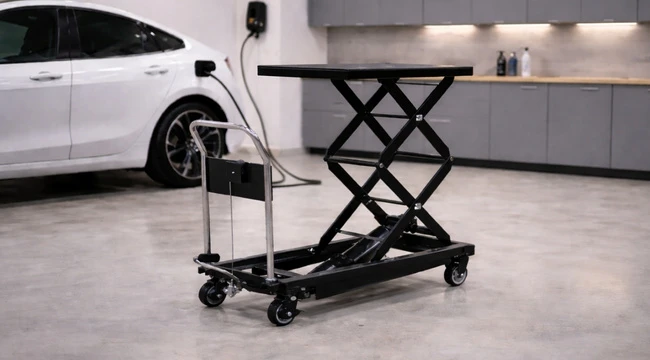
Key Features to Look For:
- Rated capacity that covers the full weight of the vehicle including its high-voltage battery pack
- Correct lifting point adapters to protect EV and hybrid underbody components
- Stable support and secure contact points to prevent movement during service
- Adjustable height and platform size suitable for different vehicle types
- Safety certifications for professional automotive workshop use
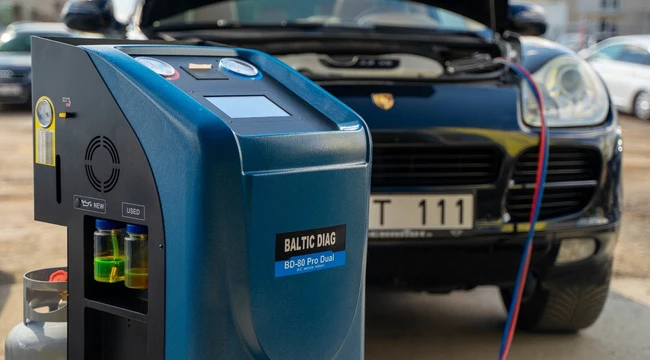
Coolant & air conditioning service equipment
Electric vehicles may not have a traditional engine cooling circuit, but they still rely on liquid cooling to regulate battery temperature, inverters, and power electronics. Hybrid vehicles are more complex in this regard - they typically operate two separate cooling loops: one for the combustion engine and one for the high-voltage battery and electric drive components. Correct hybrid cooling system service requires equipment that can handle both loops independently, without cross-contamination between circuits.
Air conditioning systems in EVs and hybrids are not only used for cabin comfort but also play a role in cooling high-voltage components. Service equipment must be compatible with non-conductive POE oil used in EV-safe compressors, and must support both R134a and R1234yf refrigerants found across the current vehicle fleet. Using EV coolant flush equipment and A/C stations designed for electrified vehicles ensures that both thermal management systems are serviced correctly and safely according to manufacturer specifications.
Key features to look for:
- Controlled flushing and refill functions for both EV battery cooling loops and hybrid engine cooling circuits
- Compatibility with EV refrigerants and non-conductive POE oil for EV-safe compressor protection
- Support for R134a and R1234yf refrigerant types to cover the full range of current EV and hybrid models
- Automatic or semi-automatic operation for efficient, repeatable service cycles
- Built-in vehicle database or manual input support for fast setup across different makes and models
Solutions from BalticDiag BalticDiag:
BalticDiag
BD-093 automatic A/C service station (R134a)
Recover, vacuum, leak test, inject non-conductive POE oil, and refill A/C systems in EVs and hybrids. Dedicated POE oil tank for safe compressor servicing.
BalticDiag
BD-80 PRO automatic A/C service station (R134a)
Refrigerant recovery, vacuuming, leak testing, oil extraction, and refill. Large casters for mobility; supports a wide range of EV and hybrid vehicle models.
BalticDiag
BD-80 PRO DUAL EXTRA (R134a + R1234yf)
Dual-refrigerant support with built-in composition analysis and a large vehicle database. Suited for a wide range of EVs and hybrid systems.
BalticDiag
BD-90 PRO automatic A/C service station (R1234yf)
Automatic extract, vacuum, refill, oil injection, and system diagnostics for R1234yf systems found in newer EV and hybrid models.
For guidance on selecting the most suitable model for your workshop, contact BalticDiag for expert recommendations.
Battery service: charging, discharging & maintenance equipment
Charging and discharging equipment is used to safely supply and remove energy from high-voltage traction battery systems during maintenance, testing, balancing, and service routines. This equipment is equally relevant for full EVs and hybrid vehicles. In PHEVs and full hybrids, the traction battery undergoes the same types of capacity degradation, cell imbalance, and charge cycle wear as EV packs — and requires the same controlled EV battery capacity test and reconditioning procedures.
For mild hybrids, 48 V battery service requires equipment with lower voltage and current ranges than full EV packs. This makes adjustable units essential for any hybrid battery reconditioning workflow, particularly in workshops servicing mixed fleets of EVs, PHEVs, and MHEVs. A battery health check using dedicated charge and discharge equipment provides measurable insight into remaining capacity and cell balance — information that simple OBD diagnostics alone cannot always reveal
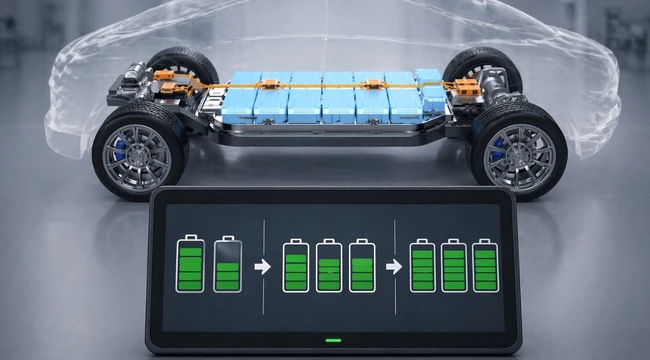
Key features to look for:
- Adjustable current and voltage to match EV, PHEV, and 48 V MHEV traction battery specifications
- Built-in protection against overcurrent, overvoltage, and reverse connection for safe operation
- Real-time monitoring of individual cell and pack voltages for accurate battery health check results
- Data visualisation and reporting to support EV battery capacity test documentation
- Multi-function capability combining charging, discharging, and cell balancing in one unit
Solutions from BalticDiag:
SmartSafe
EP401 EV battery charge & discharge equipment
Charging, discharging, and balancing for traction battery pack modules. Supports multiple voltage levels with real-time cell and pack monitoring for comprehensive battery health checks.
Launch
ELP400 professional charger & discharger
Adjustable charging and discharging with clear voltage visualization. Includes safety protections and is suited for regular EV battery capacity testing and performance improvement tasks.
Autel
MaxiEV CDT100 battery discharge & charge unit
Adjustable charge/discharge currents, detailed cell voltage and temperature reporting, and multiple protection features for thorough hybrid battery reconditioning and EV battery conditioning.
Why choose BalticDiag for EV & HEV workshop equipment
Setting up or upgrading a workshop for electric and hybrid vehicles requires not only the right equipment, but also a reliable EV tools supplier who understands modern vehicle technologies. BalticDiag offers a wide selection of professional automotive equipment specifically suited for EV and hybrid vehicle service - from advanced diagnostic scanners and EV technician tools to battery service equipment and A/C service stations - all available from a single trusted source.
Dealer-grade equipment
Professional tools and diagnostic systems meeting manufacturer-level standards for EV and HEV servicing.
Large product selection
A comprehensive range of diagnostic tools, electrical safety testers, lifting solutions, and battery service tools in one place.
Fast worldwide delivery
Reliable shipping with DHL, UPS, and FedEx Express, ensuring quick delivery to workshops globally.
Top-rated customer support
Experienced team providing assistance before and after purchase, helping workshops choose and use the right EV workshop equipment.
Trusted reputation
Highly rated by customers with a Trustpilot score of 4.6, reflecting consistent service quality and reliability.